Guide
Cold chain trucking in Saudi Arabia: reefer trailers and temperature records
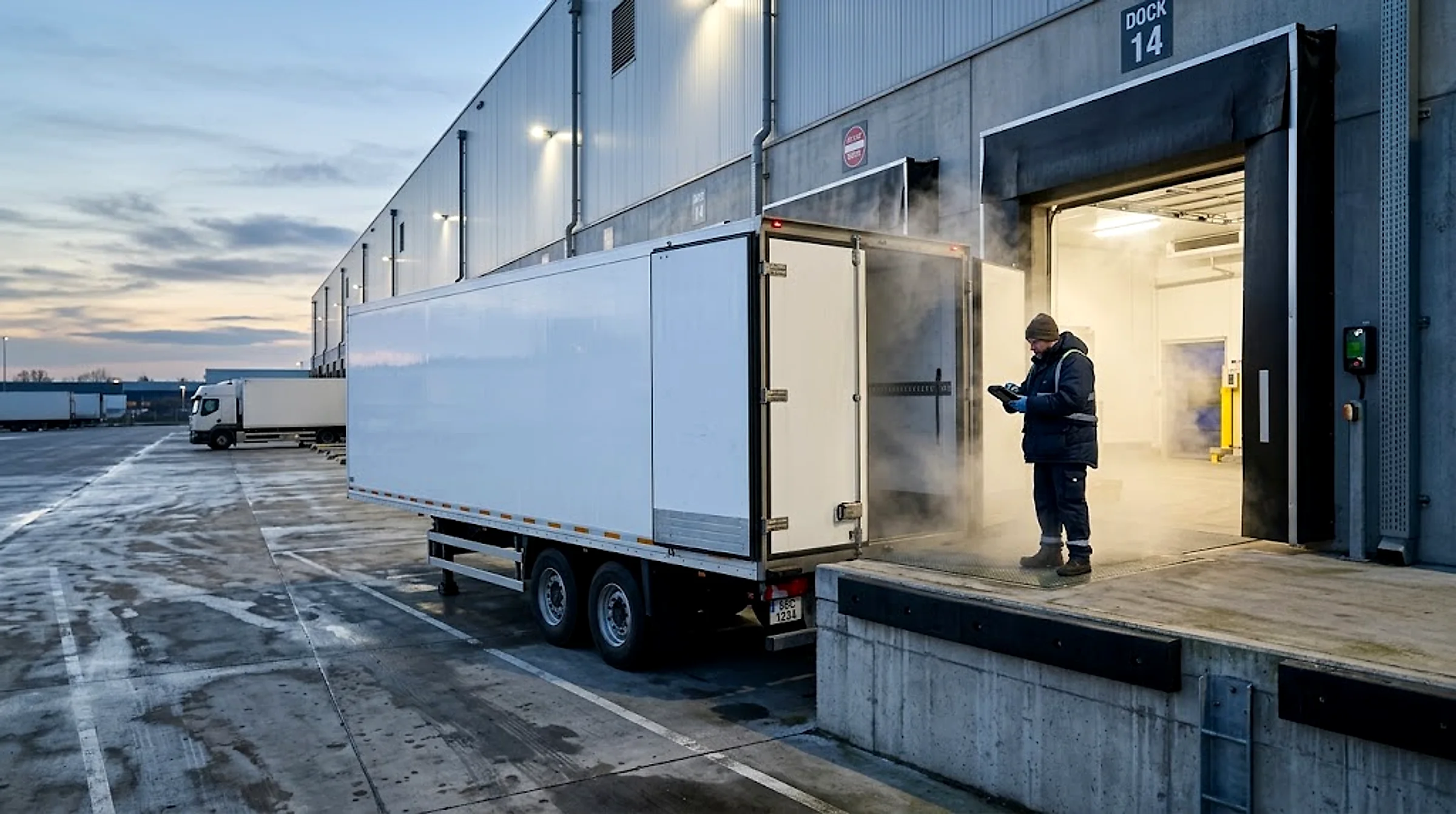
Cold chain trucking in Saudi Arabia runs on a reefer trailer rated up to about 26 tonnes on a 13.6 m deck, pre-cooled before loading, loaded to keep airflow around the pallets, and backed by a continuous temperature record handed over with the shipment. Agreeing the required temperature range and checkpoints with the carrier upfront is what prevents disputes at delivery.
A cold shipment that drifts out of its required range can be rejected on arrival even if it lands on time. Cold chain trucking is not just “a truck with cooling”; it is a chain of decisions from choosing the trailer to loading it to the record that proves the temperature held all the way. This guide covers each step.
Choosing the reefer trailer
A standard reefer trailer on a 13.6 m deck carries up to about 26 tonnes — the same size class as a box trailer, but fitted with an active cooling unit that controls temperature rather than just insulating. Confirm the cooling unit is running and showing a temperature reading before you accept the truck, not after it is loaded.
| Trailer type | Active cooling | Good for |
|---|---|---|
| Insulated box (no cooling) | No | Goods that tolerate a small temperature swing |
| Reefer, single unit | Yes | A load with one temperature range |
| Reefer, multi-zone | Yes, separate zones | A mixed load with different ranges on the same trip |
Pre-cooling before loading
Start pre-cooling the trailer before the goods reach the loading point, so the trailer’s temperature already matches the product’s range the moment the doors open. Loading cold goods into a warm trailer creates a temperature gap that is hard to recover later, even with the cooling unit running well for the rest of the trip.
Loading practice that protects the cold chain
How the load is stacked affects the temperature as much as the cooling unit itself.
- Leave clearance from the walls. Pallets pressed against the trailer walls block cold air from circulating around them.
- Don’t block the vents. Many reefer trailers rely on airflow from floor to ceiling; a tightly packed load can stop that flow.
- Separate different temperature ranges. For a mixed load, use a bulkhead inside the trailer rather than relying on a middle-ground temperature that suits nothing well.
- Minimize door-open time. Every door opening during a stop raises the trailer’s temperature a little; plan loading and unloading to keep openings to a minimum.
The temperature record: what settles a dispute
A continuous temperature record is the most important document on a cold shipment after the shipping document itself. Without it, any dispute about whether the goods stayed safe becomes the shipper’s word against the carrier’s against the receiver’s.
- Log temperature continuously through the trip, not just at scattered stops.
- Time-stamp every reading so any drift can be pinned down precisely.
- Keep the record as a standalone attachment handed over with the shipment, so the receiver reviews it at delivery, not afterward.
- If a drift happens, note its duration and cause if known — that is what determines the next decision on the product.
What to agree with the carrier before the trip
A clear agreement before loading heads off most of the problems that surface at delivery.
- The required temperature range for each product in the shipment, following the manufacturer’s or the relevant standard’s instructions for that specific product.
- Whether there will be more than one drop-off point, and how that affects door-open time.
- The agreed step to take if the temperature drifts out of range in transit.
- Who receives the temperature record at delivery, and how it attaches to proof of delivery.
Book a reefer trailer at an upfront price
In the Mirabk app you pick the reefer trailer and the pickup and drop-off points, and one upfront price appears before you book. A verified driver accepts, and you follow the shipment on the map through to a documented proof of delivery.
Frequently asked questions
What is the difference between a reefer trailer and a box trailer?
A box trailer is insulated but has no active cooling unit, and suits goods that can tolerate some temperature swing. A reefer trailer has an active cooling unit that controls temperature throughout the trip, rated up to about 26 tonnes on a 13.6 m deck, and is the only right choice for food and pharma.
Why does the trailer need pre-cooling before loading?
Loading cold goods into a warm trailer raises their temperature immediately, before the trip even starts, and can push them out of range without it showing until later. Pre-cooling brings the trailer's temperature at load time in line with the product's own temperature.
Who checks the temperature record at delivery?
Usually the receiver, or the quality team at the receiving site. The record is attached to the proof-of-delivery document and is the first reference in any dispute about whether the shipment stayed safe.
Do all food products need the same temperature range?
No. Each product has its own range set by the manufacturer or the relevant standard, and chilled products differ from frozen ones. Follow the range required for each specific product rather than assuming one range fits the whole load.
What happens if the temperature drifts out of range in transit?
The right response depends on the product and how long the drift lasted, which is why you agree a clear step with the carrier in advance instead of deciding mid-route.