Trucks
Lowbed Truck: Definition and Max Load Up to 40 Tonnes
A lowbed is an articulated trailer with a low deck close to the road, rated up to about 40 tonnes on a 13 m deck, making it the highest-capacity truck among rigid trucks and trailers. Its low deck is built specifically to carry heavy, tall equipment such as excavators and cranes without exceeding road height limits.
Moving an excavator or crane isn’t just putting it on any trailer — excess height means it won’t clear a bridge, and excess weight needs a trailer built for above-average capacity. This definition covers what a lowbed is, its maximum payload, and exactly when you need it over other trucks.
What is a lowbed?
A lowbed is an articulated trailer with a deck sitting much closer to the ground than a standard trailer. That lowered deck is what defines it: it lets tall equipment sit on the rig without the combined height — tractor unit plus deck plus equipment — exceeding road and bridge clearance limits.
Lowbed payload and length
| Spec | Value |
|---|---|
| Max payload | 40 t |
| Deck length | 13 m |
| Chassis type | Articulated trailer, low deck |
| Primary use | Heavy, tall equipment |
This payload makes the lowbed the highest-capacity truck available, surpassing the standard trailer (28 t) and the container chassis (30 t), because it’s designed for the heaviest class of industrial equipment.
When you specifically need a lowbed
- Equipment over 12 tonnes. Anything heavier than a flatbed’s limit needs a trailer built for higher capacity.
- Tall equipment. Excavators, cranes and drilling machinery whose height would exceed the clearance on a standard trailer.
- Heavy, concentrated weight. Equipment whose weight sits at one point needs a deck and frame built for that load distribution.
- Moves between industrial or construction project sites. Where the equipment is moved whole, without disassembly.
Lowbed vs flatbed and standard trailer
A flatbed is a rigid truck rated at only 12 tonnes — far smaller than a lowbed and not built for heavy equipment. A standard trailer carries 28 tonnes at normal deck height, suited to packaged goods and general cargo, but it doesn’t solve the height problem a lowbed solves. A lowbed is the only one of the three that works when both weight and height exceed normal limits.
Book a lowbed at an upfront price
In the Mirabk app, pick the lowbed as your truck type for heavy equipment, and set the pickup and drop-off points, and one upfront price appears before you book. A verified driver accepts the load, and you follow the equipment on the map through to proof of delivery.
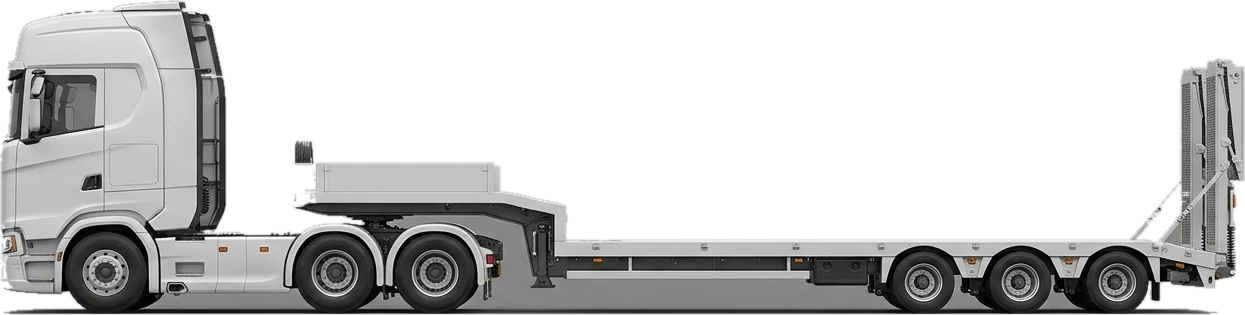 Lowbed40 t · 13 mSee this truck
Frequently asked questions
What is a lowbed's maximum payload?
A lowbed's maximum payload is about 40 tonnes, with a 13 m deck, making it the highest-capacity truck among the twelve common types used in Saudi Arabia.
Why is a lowbed's deck low?
A low deck reduces the gap between the loaded equipment and the road surface, allowing tall machinery like excavators and cranes to be carried without the combined rig height exceeding bridge and tunnel clearances.
What's the difference between a lowbed and a standard trailer?
A standard trailer has a normal deck height and carries up to 28 tonnes, suited to packaged loads and general cargo. A lowbed has a low deck and a higher payload of about 40 tonnes, built specifically for heavy, tall equipment.
When do I need a lowbed instead of a flatbed?
When the equipment weighs more than 12 tonnes, a flatbed's limit, or when it's tall enough to need a low deck to stay within road height limits. Excavators, cranes and heavy industrial machinery need a lowbed, not a flatbed.