Trucks
Reefer Trailer: Definition, Payload and When You Need One
A reefer trailer is an articulated trailer with a fully enclosed box fitted with a refrigeration unit that holds a steady temperature throughout the trip, rated up to about 26 tonnes on a 13.6 m deck. It's used for any cargo that needs constant temperature from pickup to delivery, such as fresh and frozen food and medicine.
Cargo that arrives late costs time. Cargo that arrives at the wrong temperature loses its value entirely. That difference is why the reefer trailer exists as its own category, separate from every other truck. This definition covers what it is, its payload, and exactly when you need it.
What is a reefer trailer?
A reefer trailer (also called a refrigerated trailer) is an articulated trailer with a fully enclosed box, fitted with a mechanical refrigeration unit that runs throughout the trip to hold a steady temperature inside, regardless of the outside temperature on the road. This is what sets it apart from a regular box trailer, which encloses cargo without controlling its temperature.
Reefer trailer payload
| Spec | Value |
|---|---|
| Max payload | 26 t |
| Deck length | 13.6 m |
| Chassis type | Articulated trailer, enclosed refrigerated box |
| Core feature | Steady temperature control throughout the trip |
The payload is slightly lower than a flatbed trailer’s (28 t) because the insulated walls and refrigeration unit add weight that other types don’t carry.
When you need a reefer trailer
- Fresh or frozen food. Any temperature-sensitive food product that loses quality or shelf life outside a set temperature range.
- Perishable agricultural produce. Fruit and vegetables that need a steady low temperature to extend shelf life during transport.
- Medicine and vaccines. Often require an unbroken cold chain from manufacturing to receipt, and any break in it can ruin their effectiveness.
- Cargo bound by a supply agreement requiring a set temperature. Where holding temperature is part of the acceptance terms at delivery.
Reefer vs box trailer
A regular box trailer protects cargo from external factors — dust, rain and unauthorized access — but doesn’t control internal temperature, so it’s gradually affected by the surrounding climate. A reefer adds a core layer: actual control of internal temperature regardless of outside conditions, and that difference is what makes it mandatory, not optional, whenever the cargo is temperature-sensitive.
Book a reefer trailer at an upfront price
In the Mirabk app, pick the reefer trailer as your truck type for temperature-sensitive cargo, and set the pickup and drop-off points, and one upfront price appears before you book. A verified driver accepts the load, and you follow the shipment on the map through to proof of delivery.
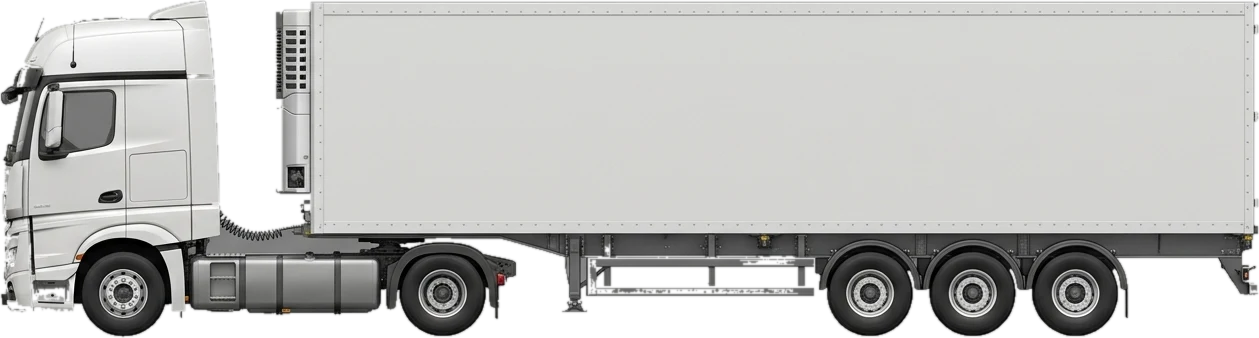 Reefer trailer26 t · 13.6 mSee this truck
Frequently asked questions
What is a reefer trailer's payload?
A reefer trailer's maximum payload is about 26 tonnes on a 13.6 m deck, slightly less than a flatbed trailer due to the added weight of the refrigeration unit and insulated walls.
What's the difference between a reefer and a regular box trailer?
A box trailer is enclosed to protect cargo from dust and rain only, with no temperature control. A reefer has an actual refrigeration system that holds a set temperature inside the box throughout the trip, making it the required choice for temperature-sensitive cargo.
What kind of cargo needs a reefer trailer?
Fresh and frozen food, perishable agricultural produce, medicine and vaccines, and any product that loses quality or shelf life if its temperature exceeds the allowed range during transport.
Can the temperature be set differently depending on the cargo?
Yes, a reefer's refrigeration system is set to each shipment's requirements — frozen food needs a different temperature than medicine or fresh produce — and this setting is a core part of sound cold-chain transport.