Guide
Shipping heavy equipment in Saudi Arabia: lowbed vs flatbed trailer
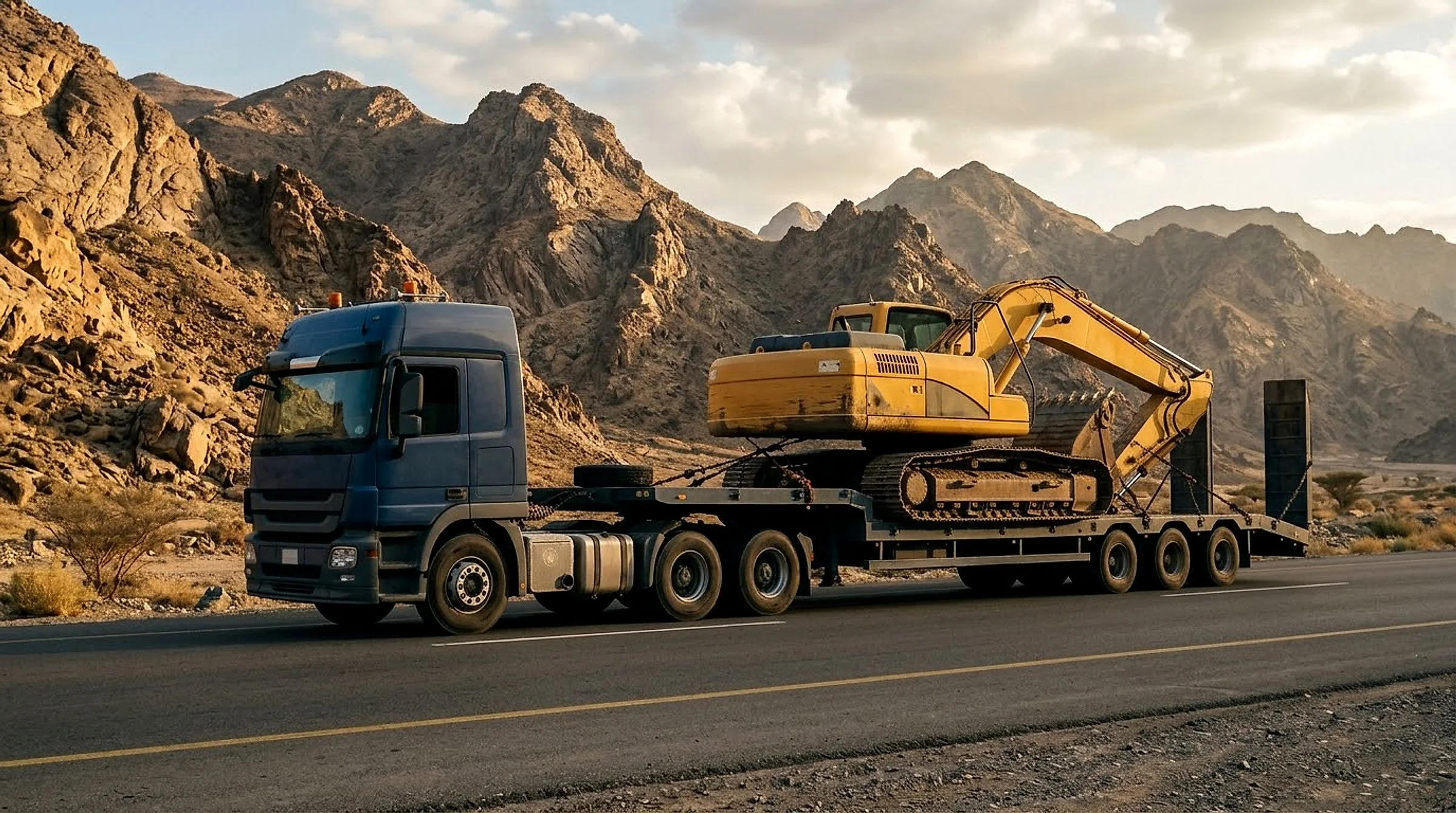
Heavy equipment under about 3 m in height and within standard trailer width can travel on a flatbed trailer; taller or track-mounted machinery such as excavators and cranes needs a lowbed, whose low deck keeps the overall height within road limits. Any load that exceeds standard weight, width or height needs an oversize permit from the relevant road authority before it moves.
Heavy equipment does not move like packaged freight. The wrong trailer means a machine that cannot be driven on safely, a height that will not clear a bridge, or a load with nowhere solid to anchor it. This guide covers how to choose between a flatbed trailer and a lowbed, prepare the load, and plan the move.
Flatbed trailer or lowbed: choose by height, not just weight
A flatbed trailer sits at normal deck height and suits equipment that is wide or long but not tall — pipe sections, prefabricated steel, or machinery already broken down for transport. A lowbed has a low deck built specifically for tall or tracked machinery, keeping the total height within road limits that a flatbed would exceed.
| Factor | Flatbed trailer | Lowbed |
|---|---|---|
| Typical payload | Up to about 28 t | Up to about 40 t |
| Deck height | Standard | Low, with loading ramps |
| Best for | Wide or long loads under about 3 m tall | Excavators, cranes, tracked machinery |
| Loading method | Forklift or crane | Driven or winched up ramps |
If the machine is tracked, has a raised boom or cab, or is rated for a weight a standard trailer axle group cannot carry, plan for a lowbed from the start rather than finding out at the yard gate.
Prepare the load before the trailer arrives
Preparation decides how smoothly loading goes. Before the truck is booked, walk through the same checklist a rigging crew would use:
- Confirm the exact dimensions and weight — height with any boom or attachment raised to its transport position, width, length, and gross weight including fuel and attachments.
- Lower or remove what can be lowered — booms, buckets, antennas and mirrors that raise the transport height should be folded, removed or secured in the lowest safe position.
- Drain or secure fluids as the equipment manual specifies, and disconnect or cap anything that could leak in transit.
- Check the route for clearance — bridges, low wires and tight turns along the planned road, not just the total distance.
- Confirm the trailer’s ramp angle and deck length match the machine’s ground clearance and wheelbase, so it can be driven or winched on without grounding.
Securing the load: chains, chocks and lashing points
A machine that shifts in transit is a safety failure, not a minor issue. Wheeled and tracked equipment is driven or winched onto the deck, set on its own suspension or blocked with chocks front and rear, then tied down at the manufacturer’s marked lashing points — never at random frame members. Booms, blades and attachments that can swing or drop are locked and chained separately from the main tie-down. The driver checks the load again after the first few kilometres, since straps and chains can loosen once the machine settles.
Oversize width, length and height: expect a permit
A load that exceeds the standard weight, width, length or height for the road it will travel on generally needs an oversize or overweight permit from the relevant road authority before departure. Requirements vary by load and route, so this is worth confirming for your specific shipment rather than assuming a standard trailer booking covers it. Build permit lead time into your schedule: a machine that must move on a fixed date should be measured and permitted well before that date, not the day before pickup.
Plan the pickup and delivery site, not just the road
The road is only half the move. Both ends need firm, level ground for the trailer to load and unload, enough turning space for a long lowbed combination, and someone on site who knows the machine’s tie-down points and can guide the driver. A site with soft ground, overhead power lines, or no clear approach should be flagged before the truck is dispatched, not discovered when it arrives.
Book heavy equipment transport at an upfront price
In the Mirabk app you describe the equipment, choose a flatbed trailer or lowbed, and see one upfront price before you book — no back-and-forth negotiation. A verified driver accepts the load, you track it on the map from pickup to delivery, and the receiver confirms with a code once it lands.
Frequently asked questions
When do I need a lowbed instead of a flatbed trailer?
Use a lowbed when the machine is tall, tracked, or too heavy for a standard trailer axle rating — excavators, bulldozers, cranes and industrial generators. A flatbed trailer suits equipment that is wide or long but not tall, such as pipe sections or containerized gear.
Does moving heavy equipment need a permit?
Any load that exceeds standard weight, width, length or height limits needs an oversize or overweight permit from the relevant road authority before it travels. Check the requirement for your specific load and route ahead of the move.
How is heavy machinery secured for transport?
Tracked and wheeled machinery is driven or winched onto the trailer, lowered on its own suspension or blocked with chocks, then tied down with rated chains or straps at the manufacturer's marked lashing points, with the boom, bucket or arm secured separately.
Can a lowbed carry a container or general cargo?
A lowbed is built for tall, heavy machinery, not general freight — its low deck and ramps are made for driving or winching equipment on and off. For containers, a container chassis is the right vehicle; for palletized goods, a standard trailer.