Trucks
Trailer Truck: Definition, Max Payload and Subtypes
A trailer is an articulated truck (a tractor unit plus a separate trailer) with a 13.6 m deck, rated up to about 28 tonnes in its standard flatbed form. It's used for full loads between cities and comes in subtypes by cover: flatbed, curtain-side, box and reefer, each suited to a different kind of cargo.
The trailer is the backbone of intercity freight in Saudi Arabia, because a single trip’s cost spreads over a much bigger load than any rigid truck can carry. This definition covers its exact payload and its subtypes, and when to choose each.
What is a trailer?
A trailer is an articulated truck made of a tractor unit (the driving and engine part) and a separate trailer unit connected to it. This articulated design is what lets it carry a much longer deck than any rigid truck — 13.6 m versus 8.5 m for a flatbed, for example.
Trailer payload by subtype
| Trailer type | Max payload | Deck length | Use |
|---|---|---|---|
| Flatbed | 28 t | 13.6 m | Steel and building materials loaded from above |
| Curtain-side | 27 t | 13.6 m | Pallets loaded from the side |
| Box | 26 t | 13.6 m | Enclosed goods needing full protection |
| Reefer | 26 t | 13.6 m | Food and medicine at controlled temperature |
The small payload differences between types come down to each type’s structural weight: box and reefer trailers are heavier due to walls and insulation, so slightly less capacity is left for cargo.
Trailer subtypes and when to choose each
- Flatbed. No sides or cover, loaded from above by crane or forklift. Best for rebar and solid building materials.
- Curtain-side. Fabric sides that open laterally, allowing pallets to be loaded directly by forklift without lifting from above.
- Box. Fully enclosed on all sides, protecting cargo from dust, rain and unauthorized access.
- Reefer. An enclosed box fitted with refrigeration that holds a steady temperature throughout the trip, essential for food and medicine.
Trailer vs rigid trucks
The core difference between a trailer and any rigid truck (flatbed, Dyna, box truck) is that a trailer is articulated while a rigid truck is one connected frame. This gives a trailer far greater payload and length, but makes it harder to maneuver in tight sites, so it suits long distances between cities better than distribution within neighborhoods.
Book a trailer at an upfront price
In the Mirabk app, pick the trailer subtype you need — flatbed, curtain-side, box, or reefer — and set the pickup and drop-off points, and one upfront price appears before you book. A verified driver accepts the load, and you follow the shipment on the map through to proof of delivery.
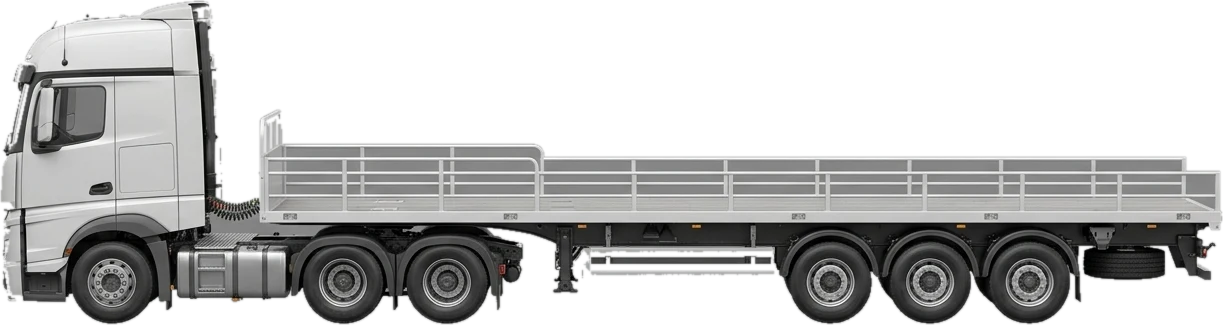 Trailer28 t · 13.6 mSee this truck
Frequently asked questions
How much does a standard trailer carry?
A standard flatbed trailer at 13.6 m carries up to about 28 tonnes. Other subtypes vary slightly: curtain-side up to 27 tonnes, and box and reefer trailers up to 26 tonnes each.
What are the trailer subtypes?
Four main types: flatbed (no sides, loaded from above), curtain-side (fabric sides that open for side loading), box (fully enclosed to protect cargo), and reefer (an enclosed, temperature-controlled box for food and medicine).
What's the difference between a trailer and a flatbed truck?
A flatbed is a rigid truck carrying only 12 tonnes, while a trailer is articulated (a separate tractor and trailer unit) carrying up to 28 tonnes, suited to full loads and longer distances between cities.
When should I choose a box trailer over a curtain-side?
A box trailer is fully enclosed and suits goods that need full protection from dust, rain and potential theft. A curtain-side loads faster from the side by forklift and suits palletized goods that don't need full enclosure.